Technical rider for small clubs: one page is enough
Line-up, channel list, backline, monitors, stage plan — what the club's sound engineer actually needs, top to bottom, on one sheet.

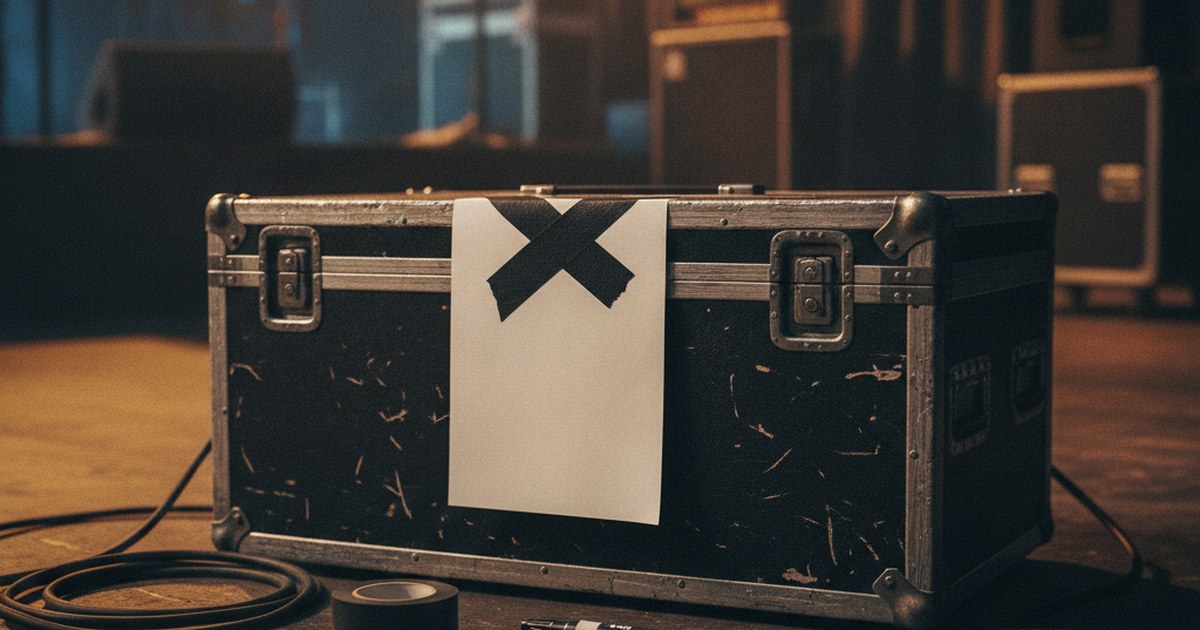
A technical rider for a small club is one page. Nobody there reads more: before you arrive, the engineer wants to know what stands on stage, what sends a signal and what they are missing. Here is the page, top to bottom.
The one page, top to bottom
Header: band, date, one number
Band name, the date of this version and a mobile number where someone answers tech questions — the band's contact number, not a private one: a rider gets forwarded, and the number travels with it. A rider without a phone number creates an email thread; a number settles the same question in two minutes.
Line-up
Who plays what, who sings — the backing vocals too. Four lines from which the engineer can already work out half the channel list.
Channel list: what sends a signal
Everything that sends a signal to the PA, as a list: how many vocal mics, which instruments go through a mic or a DI box, whether backing tracks or a keyboard come on top. If you don't know the technical terms, write it in plain words — "bass goes straight into the desk, the guitar amp gets a mic" is a complete entry.
Backline: brought and needed
Two columns: what you bring, what you need from the venue. The second column is the reason the rider exists — whatever is listed there and does not turn up gets noticed on the night, when nobody can fetch anything any more.
Monitors and anything unusual
How many monitor mixes you need and what is special about them: stereo backing tracks, a click for the drummer, an acoustic part in the set. Whatever the engineer only learns at soundcheck costs soundcheck time — and there is little of it.
Stage plan: a sketch will do
A sketch from above: where drums, amps and mics stand, where you need power. Drawn by hand and photographed is perfectly fine — the sketch answers questions faster than any paragraph of text.
What stays out
Requests for drinks and food belong in the email about the fee — the technical rider stays pure tech. For small venues you can also skip wish lists of particular microphone models: the club works with what it has, and a rider full of model numbers asks for equipment nobody there owns.
When to send the rider
The rider is sent once the booking is confirmed. In the request, what counts is whether you fit the programme; the tech becomes relevant once the night is set. What the request itself looks like is in Finding gigs.
FAQ: The stage plan, channel lists without experience and the format
Do we really need the stage plan?
For a four-piece band with a standard setup, the line-up list will do at a pinch — the engineer knows how a rock band is set up. As soon as anything departs from the standard setup, the sketch answers the questions before they are asked.
We don't know our way around channel lists — what do we write?
Write in plain words what you have on stage and which of it should go into the PA. The engineer translates that into their own terms — plain language works better than jargon used wrongly.
PDF or just text in the email?
A PDF, one page, with the band name and date in the file name. Text pasted into the email falls apart when it is forwarded: line breaks shift, the two backline columns turn into alphabet soup, and the engineer receives a quote inside a quote. A PDF survives exactly that forwarding — and a rider always gets forwarded.
Venues in Germany
97 in the catalog right now · as of 2026-10-28
- Batschkapp — Frankfurt am Main
- Blue Shell — Köln
- Lido — Berlin (Kreuzberg)
- Lila Eule — Bremen
- SO36 — Berlin (Kreuzberg)
- Sputnikhalle — Münster
- UT Connewitz — Leipzig, Saxony
- Volksbad — Flensburg
Where the rider goes
One page is enough for a small venue. How big the venue you are playing is, the directory shows, and the card almost always links the venue's own website — there you see how it describes itself.
The short version
One page, six sections: a header with a phone number, the line-up, the channel list, the backline in two columns, monitors with anything unusual, a stage plan as a sketch. In plain words, as a PDF, sent after the booking. Everything the club is to provide goes in the "needed" column — because whatever is missing there is missing on stage on the night.
Every club works differently. The rider does not replace the short conversation with the engineer on site — it keeps that conversation short.
Sources
- Stagecraft only, no external sources
Updated: 2026-09-13
General information, not legal or tax advice. Any figures are examples, not commitments.
Last reviewed: 13.09.2026
Read next
What a gig costs: a band's honest calculation
Fuel, backline, wear and tear — a worked example for an out-of-town show, and how many paying guests a door deal needs before you break even.
2026-09-13 · Georgy E.
EPK for bands: what bookers actually open
A link that plays at once, a full-length live video, three lines of text — that is the whole booking package. Plus the list of what the booker skips.
2026-09-13 · Georgy E.

Booking platforms compared: gigmit, Backstage PRO — or ask the club directly?
gigmit PRO costs 228 euros a year plus VAT, Backstage PRO nothing, an email to the club your time. What each route gets you, which band it suits and where the notice period sits.
2026-09-13 · Georgy E.
Band organisation: setlist apps, BandHelper — and what none of them covers
BandHelper for a band from 40 dollars a year, OnSong from 29.99 dollars, SetBook 99 dollars: setlists, lyrics and dates are solved. What is left open is how an idea from the rehearsal room becomes a song with agreed shares.
2026-09-13 · Georgy E.