What a gig costs: a band's honest calculation
Fuel, backline, wear and tear — a worked example for an out-of-town show, and how many paying guests a door deal needs before you break even.

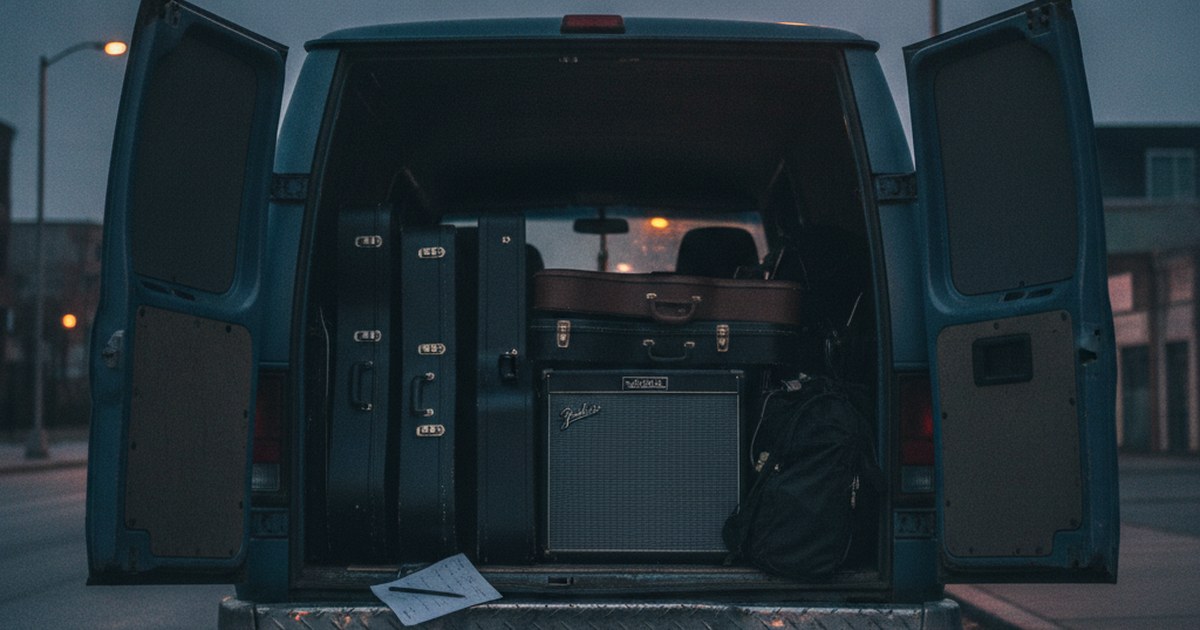
Let's run one evening through: four people, a show two hours' drive away. The numbers are an example — round and invented, so the calculation stays visible; you put in your own.
| Item | Example amount |
|---|---|
| Van: fuel there and back, share of wear and tear | €120 |
| Backline hire (the missing bass amp) | €80 |
| Food on the road, four people | €40 |
| Odds and ends: strings, sticks, gaffer tape | €20 |
| The evening costs | €260 |
Below a fee of 260 euros, this evening costs the band money. That can still be the right call — a new city, a good crowd, a venue you want to play again. But it should be a decision, not a surprise at the petrol station on the way home. The maths happens before you say yes, not after load-out.
How many guests a door deal needs
In a door deal the fee depends on ticket sales, so you keep calculating in guests. In the example: 6 euros entry, and the band gets half — 3 euros a head. Covering the evening's 260 euros takes 87 paying guests before the first euro is earned.
Now the question for the club: how many people does the room hold, and how many come on an ordinary night? If the break-even number is higher than anything the room has seen, the deal cannot work out, however good the night is. And read the deductions: a share "after costs" pushes the 87 higher still. Which costs a club may take off before the split belongs in the agreement — Contract with the club covers that point.
Your own calculation, four lines
Work out the journey
Kilometres times consumption, plus a hire van or your share of the band bus. On out-of-town shows the journey is almost always the biggest item — and the one most often forgotten.
Price in the missing gear
Whatever the venue lacks costs hire money or a loan with a return date. What is missing shows up in the rider exchange — ask there at the latest.
Set a flat rate for consumables
Food, strings, drum heads, parking — each small item is laughable on its own and a real number together. Set a realistic flat rate per evening; in the example above it is 20 euros.
Compare with the offer, then say yes
Put the total next to the offer: is the fixed fee above or below it? For a door deal — how many guests to break even, and is that number realistic in this room? Only then say yes. How the request itself works is in Finding gigs.
FAQ: Losing money, your time and the overnight stay
Can we play even if it doesn't add up?
Sometimes, yes — a new city, a slot before the right band, a venue that books you again. That is an investment, and with an investment you know the reason for the loss and can say it out loud. If you lose money every night, open the calculation again.
Does our time count as a cost?
The table counts cash; your time is not in it. Don't forget it anyway — four people, a full day: that is the stake lying on the table next to the 260 euros.
What about the overnight stay?
If driving home after load-out becomes unrealistic, the overnight stay is a line of its own in the table — and a question for the club: some venues have somewhere to sleep or know a cheap place. Asking costs nothing; forgetting the line does.
Venues in Germany
97 in the catalog right now · as of 2026-10-28
- Batschkapp — Frankfurt am Main
- Blue Shell — Köln
- Lido — Berlin (Kreuzberg)
- Lila Eule — Bremen
- SO36 — Berlin (Kreuzberg)
- Sputnikhalle — Münster
- UT Connewitz — Leipzig, Saxony
- Volksbad — Flensburg
Where the evening happens
The question for the club — how many people does the room hold? — the directory answers before you ask: almost every venue there lists its approximate capacity. Put your break-even guest count next to it before you write the first email.
The short version
Four lines before every yes: journey, missing gear, consumables, total — 260 euros in the example. Fixed fee: above or below the total? Door deal: work out the guests to break even and compare with the room; deductions before the split belong in the contract. Losing money is fine when it is a decision — the calculation turns surprises into decisions.
All amounts are a worked example with round, invented numbers. Your own calculation uses your own numbers. Every amount here is one worked example with round, invented numbers. Your own calculation runs on your own numbers.
Sources
- No external sources; the embedded venue list comes from the Produser directory and is recounted on every page load
Updated: 2026-09-13
General information, not legal or tax advice. Any figures are examples, not commitments.
Last reviewed: 13.09.2026
Read next
Technical rider for small clubs: one page is enough
Line-up, channel list, backline, monitors, stage plan — what the club's sound engineer actually needs, top to bottom, on one sheet.
2026-09-13 · Georgy E.
EPK for bands: what bookers actually open
A link that plays at once, a full-length live video, three lines of text — that is the whole booking package. Plus the list of what the booker skips.
2026-09-13 · Georgy E.

Booking platforms compared: gigmit, Backstage PRO — or ask the club directly?
gigmit PRO costs 228 euros a year plus VAT, Backstage PRO nothing, an email to the club your time. What each route gets you, which band it suits and where the notice period sits.
2026-09-13 · Georgy E.
Band organisation: setlist apps, BandHelper — and what none of them covers
BandHelper for a band from 40 dollars a year, OnSong from 29.99 dollars, SetBook 99 dollars: setlists, lyrics and dates are solved. What is left open is how an idea from the rehearsal room becomes a song with agreed shares.
2026-09-13 · Georgy E.